




Every logistics and transportation company running a GPS fleet management system knows where every vehicle is at every moment. What most of them do not know is whether the person driving that vehicle is the licensed, certified, authorised driver it is assigned to. A ghost driver, an unlicensed colleague, or an unauthorised operator can take a company vehicle with no GPS record of who is behind the wheel. When that vehicle is involved in an incident, the liability falls on the company. This article covers five specific security gaps in logistics and transportation that GPS cannot close and explains how vehicle-mounted biometrics and loading dock access control close each one.
Vehicle-Mounted Biometrics with GPS: Track Drivers and Location Together
The single most dangerous blind spot in fleet management is the gap between the vehicle and the driver. A GPS tracker tells you that Vehicle 47 is currently on the M25 northbound at 82 kilometres per hour. It does not tell you whether the person driving Vehicle 47 is Rajan Sharma, who is assigned to that vehicle, has a valid HGV licence, and passed last month’s driver assessment, or whether it is Rajan’s colleague Arjun, who borrowed the keys this morning because his own vehicle was in the workshop.
From a fleet management perspective, those two scenarios look identical on the GPS dashboard. From a liability perspective, they are completely different. If Arjun is involved in an accident, the company faces exposure for permitting an unchecked driver to operate a commercial vehicle. If Rajan is scheduled for a compliance check today and is nowhere to be found, the GPS will not surface that discrepancy either.
How vehicle-mounted biometric GPS tracking closes the identity gap
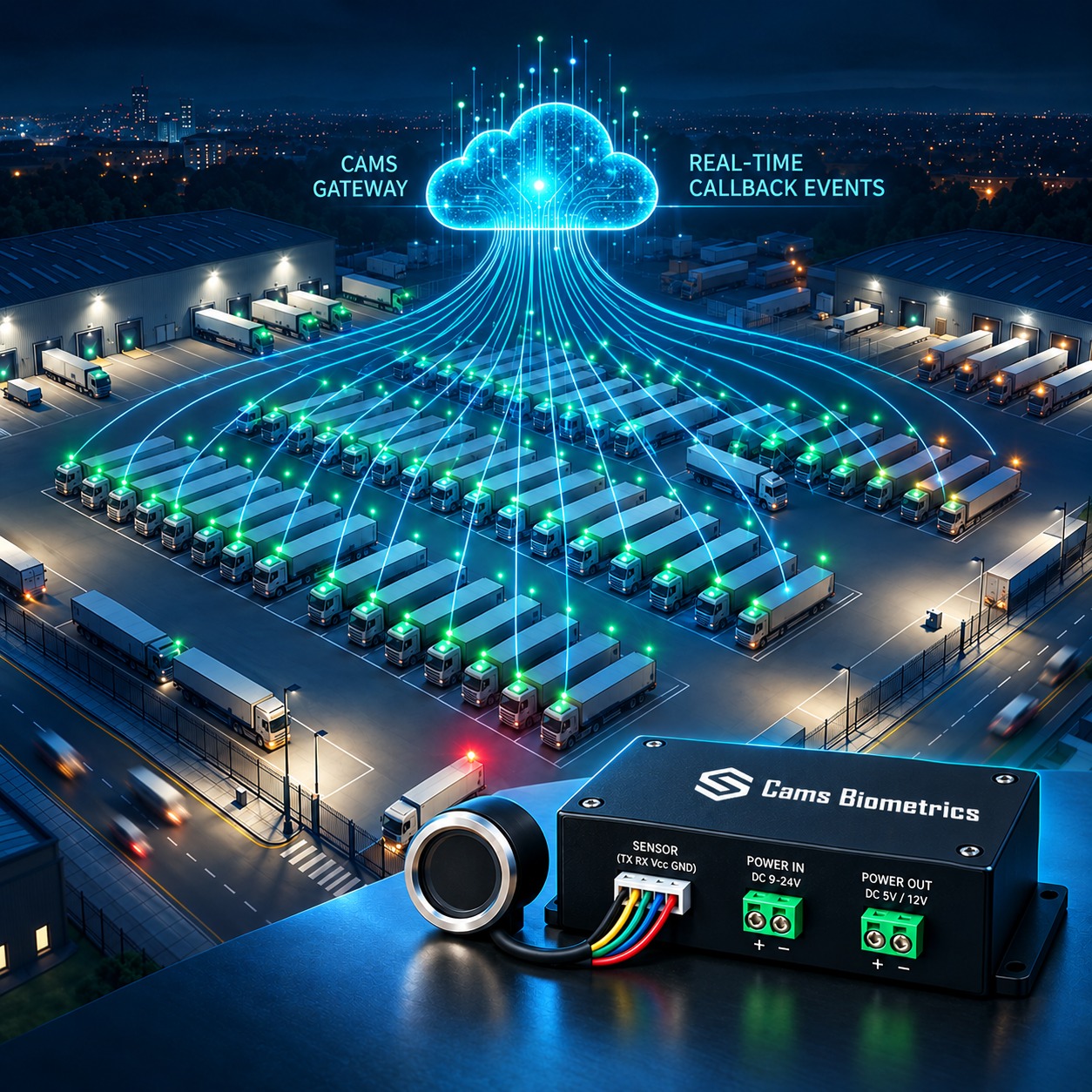
A vehicle-mounted biometric terminal installed in the cab requires the driver to verify their identity before the vehicle can be operated. The fingerprint or face recognition scan produces a biometric event that the Cams Gateway Callback API pushes to your fleet management system with the driver’s ID, the vehicle’s location at the time of the scan from the integrated GPS, and a precise timestamp. Your fleet management software receives both streams simultaneously: confirmed driver identity and verified location at the same moment.
Every time a driver starts a shift, your fleet management software receives a biometrically verified record of who is operating which vehicle at what location. If a vehicle moves without a corresponding biometric start event, your software can detect the anomaly and surface it. If an unlicensed colleague takes a vehicle, the absence of their biometric enrolment in the system means the attempt to start the vehicle fails at the terminal. Cams Gateway pushes the verified event data to your fleet system. Your fleet system applies the compliance rules.
Warehouse Biometric Attendance at Loading Docks
The loading dock is the highest-risk area in any logistics warehouse. It is the point where cargo changes hands, where vehicles arrive and depart, and where the boundary between secured warehouse space and public road is at its most permeable. It is also, in most operations, the area with the weakest access control. A staff badge check at the main entrance does not prevent an unauthorised person from tailgating a vehicle through an open dock door. A paper sign-in at the dock supervisor’s desk does not verify the identity of a delivery driver arriving from an external logistics partner.
Cargo theft at loading docks costs the global logistics industry billions of dollars annually. A significant proportion of that theft is opportunistic and involves people who should not have been in the dock area at all. Not external thieves who forced entry, but individuals who were present because access control at loading docks is typically the weakest point in the facility’s security perimeter.
In most warehouses, the loading dock operates on implicit trust. Regular drivers are recognised by dock supervisors after a few visits. Casual workers brought in for peak periods receive minimal vetting. Contractor staff from third-party logistics partners may not be enrolled in any access control system at all. The result is a high-value area where cargo is most vulnerable operating with the lowest verification standard in the facility.
Biometric access control matrix for warehouse loading dock zones
A structured biometric access control deployment at warehouse loading docks uses Cams Gateway to manage three distinct access zones, each with different verification requirements appropriate to the risk level of that zone.
Each access zone has a Cams-connected biometric terminal. When a staff member or authorised driver scans at a zone entrance, the Cams Gateway Callback API pushes the event to your warehouse management system with the person’s ID, the zone name from the LabelName field, and the timestamp. Your warehouse system receives this data and applies its own access rules. An enrolled contracted driver attempting to enter the cargo staging area generates a scan event that your system identifies as an unauthorised zone attempt and flags accordingly. Cams Gateway delivers the verified identity and location data. Your warehouse system makes the access decision based on your configured zone rules.
Contracted drivers from external logistics partners are enrolled through the Cams RESTful API with time-limited access credentials. A driver scheduled to deliver on Tuesday between 08:00 and 12:00 is enrolled for that window only. When the window expires, the credential is automatically inactive. No one needs to physically remove the driver from the system. The RESTful API call that created the access also defines when it ends.
Fleet Management: Biometric Ignition Control and Tracking
Fleet biometric ignition control solves the ghost driver problem at its source. Rather than detecting after the fact that the wrong person drove a vehicle, biometric ignition control prevents an unauthorised person from starting the vehicle in the first place. The ignition relay is connected to the biometric terminal in the cab. The vehicle cannot start until a recognised fingerprint or face scan is verified. If the scan fails or if the person scanning is not in the enrolled driver list for that vehicle, the ignition remains locked.
This is fundamentally different from GPS-based driver behaviour monitoring. A telematics system tells you how a driver drove. Biometric ignition control determines who was allowed to drive at all. For a logistics company operating heavy goods vehicles, tanker trucks, or refrigerated cargo vehicles where the driver’s certification status has direct legal implications, this distinction matters enormously.
How the ignition control Callback data reaches your fleet system
Cams Gateway pushes a Callback event to your fleet management system only when a driver is successfully verified. A failed scan attempt, an unrecognised fingerprint, or a situation where no scan is made at all does not generate a Callback. The attempt is logged internally on the device, but your fleet system is not notified. Your fleet system only receives confirmed, successful verifications.
This means every Callback event your fleet system receives represents a real, verified driver start. Your system can build its operational logic on that guarantee: if a Callback arrived, a verified driver started that vehicle at that location at that time. If no Callback arrived for a vehicle that was scheduled to depart, your fleet system can detect the absence of an expected event and treat that as the anomaly to investigate. The verification data your system acts on is always confirmed identity, never an attempt or a pending state.
“Biometric ignition control does not just tell you who drove the vehicle. It determines whether the vehicle moves at all. That is a fundamentally different level of fleet security.”
Continuous driver verification during long-haul routes
For long-haul logistics where a journey may last 8 to 12 hours and involve rest breaks, biometric verification at ignition start alone is insufficient. A vehicle that was legitimately started by Driver A can be operated by Driver B after a handover or rest break without any system awareness. Periodic re-verification checkpoints, triggered at defined intervals or at each restart after a break, use the same vehicle-mounted terminal to confirm that the driver currently operating the vehicle is the same one who started it.
Each re-verification generates its own Callback event with a current GPS location. The sequence of events in your fleet system creates a biometrically verified location timeline for the entire route: who was driving, where they were, and at what time, at every verified checkpoint.
Delivery Personnel Authentication with Location Proof
The last-mile delivery problem is not primarily a logistics problem. It is an authentication problem. When a customer claims their delivery was not received, the delivery company needs to prove that the right item was delivered to the right address by a verified delivery person. When a cargo shipment is short at the receiving end, the shipper needs to prove what was handed over, by whom, and where. When an insurance claim is raised against a delivery that was signed for but allegedly never arrived, the court needs irrefutable evidence of who made the delivery.
A paper signature on a delivery receipt proves that someone signed. It does not prove who delivered, whether the delivering person was an authorised employee of the logistics company, or what the GPS coordinates of the delivery vehicle were at the time of handover. Digital signature capture on a handheld device proves that someone touched a screen. It does not prove driver identity.
What a biometrically verified delivery proof record looks like
When a delivery personnel scans their fingerprint at the point of delivery using a vehicle-mounted or handheld biometric terminal, Cams Gateway produces a Callback event that your delivery management software receives. Your software assembles this into a complete delivery proof record: biometrically verified driver identity, GPS coordinates at the moment of scan, precise timestamp, and the delivery reference number your software links to the event. This record is legally defensible in a way that a paper signature or digital touchscreen capture is not.
DEL-2026-08-01-04471
EMP-3847, Biometrically Verified
VH-TRK-0192
2026-08-01 14:32:07 GMT +0530
25.2048 N, 55.2708 E
Fingerprint, Verified
COJJ7eiIPBGUfmIQPvh2PJWWDLX7OuKs
Your delivery management software builds the record above by combining the Cams Callback payload with the delivery reference and vehicle data it already holds. The biometric verification confirms driver identity. The GPS coordinates confirm location. The timestamp confirms when. These three data points together create a delivery proof record that is far more defensible than any paper or digital signature alternative.
The logistics company benefits because disputed deliveries can be resolved with verified evidence rather than a word-against-word dispute. The client whose goods were delivered benefits because there is a clear audit trail showing when and where their shipment was handed over and by whom. Insurance providers benefit because fraudulent claims based on alleged non-delivery become significantly harder to sustain against a biometrically verified location-stamped record. Courts benefit because the evidence is structured, timestamped, and independently generated rather than self-reported.
Case Study: Logistics Company Secured 1,000 Vehicles
How the deployment was structured
All 1,000 vehicles received cab-mounted biometric fingerprint terminals integrated with the existing GPS trackers. The terminals connected to Cams Gateway, which delivered biometric verification events alongside GPS coordinates to the company’s fleet management system via the Callback API. The ignition relay connection meant that no vehicle could start without a successful driver scan.
All 18 depots received biometric terminals at loading dock entry points, with the dock zone matrix configuration described in Topic 2. Permanent warehouse staff, contracted drivers, and third-party logistics partners were enrolled in separate access groups through the RESTful API, each with the appropriate zone permissions and time-limited credentials.
The 2,800 driver enrolments were completed using Cams Gateway’s bulk provisioning capability across all 18 depots. Drivers were enrolled at their home depot and their credentials were distributed to all vehicles and depots they were authorised to operate from via the Resend All Users function. The full enrolment completed across all 1,000 vehicles and 18 depots in under four hours.
Outcomes after deployment
Conclusion: GPS Alone Is Not a Security Strategy for Logistics
GPS fleet management has transformed route optimization, and driver behaviour analysis. But GPS has a fundamental limitation that no amount of satellite coverage can fix: it tracks vehicles, not people. Who is driving, whether they are authorized, whether their licence is valid, and whether they are who they say they are at the point of delivery are all questions that GPS cannot answer.
Biometric identification closes that gap. When a verified fingerprint scan at vehicle ignition produces a Callback event with GPS coordinates that your fleet system receives and acts on, you have something GPS alone cannot give you: confirmed driver identity linked to vehicle location at a specific moment in time. When that same biometric verification happens at a warehouse loading dock, you have confirmed personnel identity linked to zone access at a specific time. When it happens at a delivery point, you have irrefutable proof of who made the delivery, where, and when.
Cams Biometrics Gateway is the platform that connects vehicle-mounted biometric terminals, loading dock access control systems, and delivery authentication devices through one unified API. The Callback API delivers real-time verified identity and GPS data to your fleet management, warehouse management, and delivery management systems. The RESTful API provisions drivers, manages access zones, and handles credential updates across 1,000 vehicles and 18 depots through a single call. All communication uses JSON over HTTPS with optional AES-256 encryption. Explore the full fleet and logistics capability at CamsBiometrics.com about securing your fleet.