




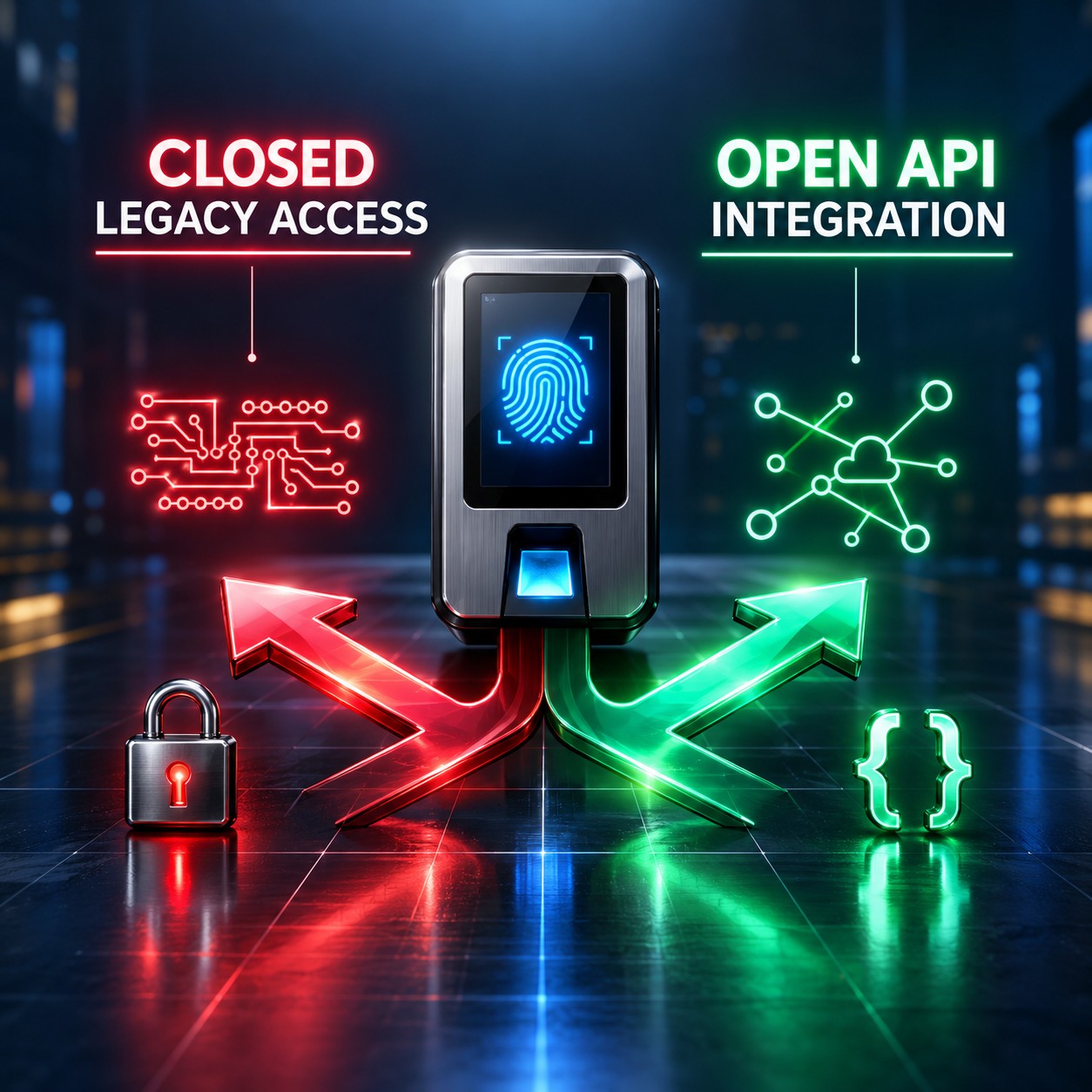
Every biometric device that only works with one piece of software, every proprietary SDK that requires a legal agreement to download, every binary protocol that is deliberately left undocumented: these are not the inevitable results of complex hardware engineering. They are decisions. This article examines what those decisions are, why they get made, and what the hardware ecosystem looks like when they are made differently.
What Vendor Lock-In Actually Means in Biometric Hardware
Vendor lock-in is the condition in which a customer becomes dependent on a specific supplier for products or services in a way that makes switching to a competitor disproportionately difficult or expensive. In enterprise software, this is a well-understood phenomenon. ERP systems, cloud platforms, and database engines all have well-documented lock-in strategies. But in biometric hardware, lock-in operates through mechanisms that are less often discussed and less often recognised for what they are.
In the biometric device market, lock-in is primarily technical rather than contractual. The mechanism is the proprietary protocol. A manufacturer builds a fingerprint reader or face recognition terminal that communicates using a binary format they designed, that only their own software understands, that requires their SDK to decode, and that is not documented in any publicly accessible specification. The result is a device that functions perfectly but is effectively useless to any software system other than the one the manufacturer sells alongside it.
When your attendance management software reaches end of life, or when you want to integrate biometric data with your HRMS, or when you want to connect the device to an automation workflow, you discover that the device is not actually a general-purpose data collection tool. It is a peripheral for one specific application. Everything else requires the manufacturer’s permission, the manufacturer’s SDK, and in most cases, the manufacturer’s ongoing commercial relationship.
Biometric hardware is genuinely complex. Fingerprint sensor engineering, liveness detection algorithms, and template storage are legitimately difficult problems. But the communication protocol, how the device sends data over a network, is not inherently complex. HTTP and JSON are simple, open, and universally understood. The choice to use a binary proprietary protocol instead is not driven by the physics of biometric capture. It is driven by something else.
The Three Mechanisms Through Which Biometric Lock-In Works
Biometric vendor lock-in does not operate through a single mechanism. It operates through three reinforcing layers, each of which creates a separate switching cost. Understanding each one separately is important because dismantling lock-in requires addressing all three, not just one.
“Each layer of biometric vendor lock-in could have been designed differently. Open protocols, redistributable client libraries, and standard export formats all exist. The choice to use none of them is a decision about business model, not technical necessity.”
Why This Design Choice Gets Made
The honest answer is that proprietary protocols and closed ecosystems are commercially rational for hardware manufacturers in markets with high switching costs. When your device is the only way to access your device’s data, you have pricing power, renewal leverage, and a guaranteed market for your software products. This is not a uniquely biometric strategy. It is a standard approach in industrial hardware markets where network effects and data accumulation create natural stickiness.
There is also a legitimate historical reason. Biometric device communication protocols were designed in an era when the internet-connected, cloud-hosted, API-first software architecture that is now standard simply did not exist. A persistent binary TCP connection to a desktop application was the correct design for 2003. The protocols were not designed to be hostile to integration. They were designed for a world where integration was not a concept anyone was designing for.
The problem is that most of these protocols have not changed meaningfully since then. The hardware has evolved substantially, sensors are better, algorithms are faster, recognition accuracy is higher. But the communication layer, the part that determines whether the device can participate in a modern software ecosystem, is still running on assumptions from twenty years ago. And unlike hardware evolution, which requires physical engineering, updating the communication protocol is a software decision. It requires choosing to do it.
A manufacturer releasing a new biometric terminal in 2026 faces a genuine choice. They can implement a standard REST API with JSON output over HTTPS, documented publicly, callable by any HTTP client without a licence agreement. Or they can implement the same proprietary binary protocol they have used since 2005, distributed through a licenced SDK, requiring an on-premises installation.
The second option costs almost nothing additional to implement, because the protocol already exists. The first option requires building something new. It also means that customers could more easily switch to a competitor’s hardware without losing their software integrations, which changes the commercial dynamics of the relationship.
The choice between these two options is not a technology decision. It is a business model decision. And in most of the biometric hardware market, the answer has consistently been the second option.
What the Alternative Actually Looks Like
It is useful to be specific about what a biometric device ecosystem without vendor lock-in looks like, because the argument against it is often that open standards would somehow reduce device capability. This is not true. The biometric functions of the hardware, fingerprint capture, liveness detection, face recognition, template matching, are entirely separate from the communication protocol. A device can be technically excellent at biometric capture and still communicate over a fully open, standardised API.
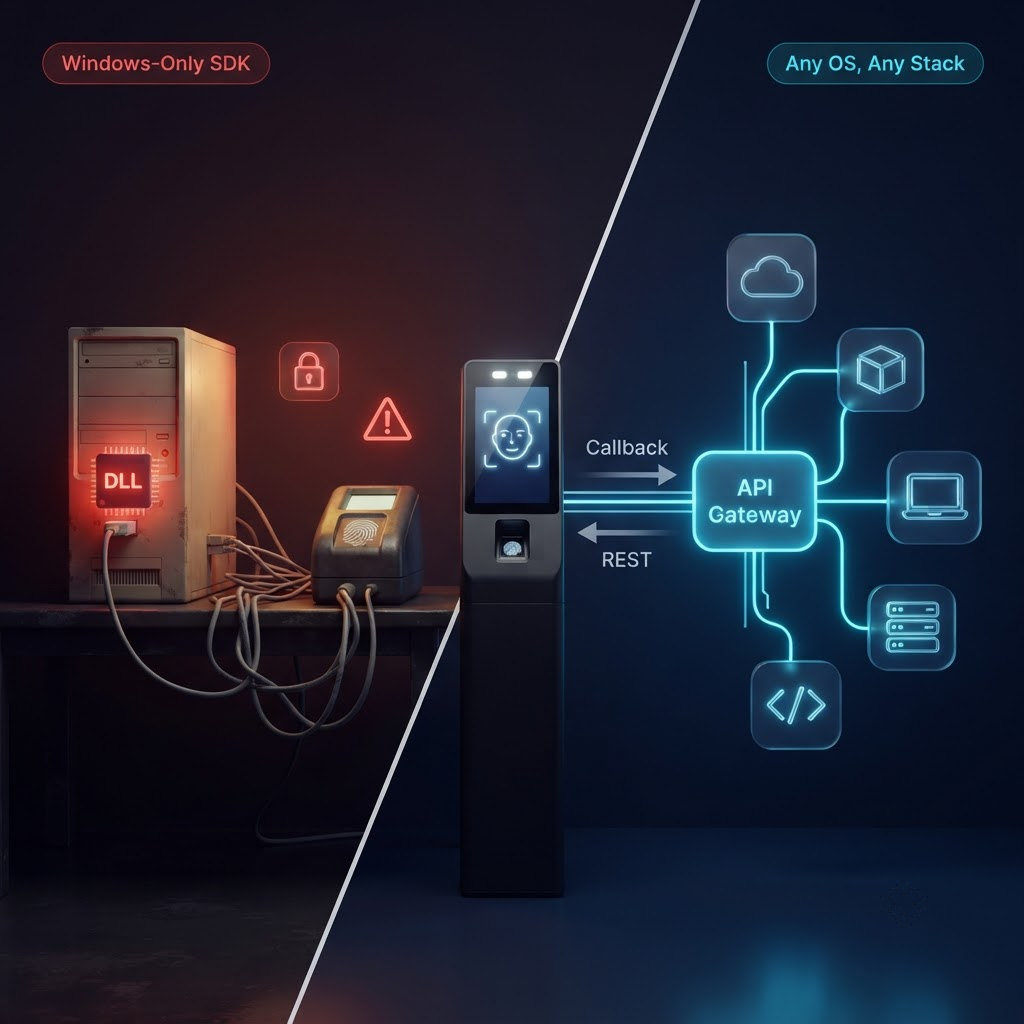
Binary TCP protocol. Proprietary packet format. SDK required for all access. SDK is licenced and on-premises only. Data stored in proprietary database. Firmware updates can break integrations. Migration requires vendor assistance or data rebuild.
HTTPS with JSON payloads. Publicly documented API specification. Any HTTP client can connect with no license agreement. Cloud-native compatible. Data exportable in standard formats. Firmware updates maintain API backward compatibility. Migration preserves existing integrations.
The open design is not hypothetical. Every SaaS product built in the last decade uses it. Payment terminals, IoT sensors, smart building systems, and industrial monitoring hardware have all moved to open API architectures. The biometric device market has been slower, but the direction of the industry is not in question. The question is only how quickly individual manufacturers choose to move.
The Real Costs Paid by Organization Running Closed Biometric Systems
Vendor lock-in has costs that are real but often not attributed to the lock-in itself. They appear as integration project costs, migration project costs, consultant fees, delayed implementations, and IT maintenance overhead. Because these costs are spread across years and across different budget lines, they rarely get accounted for as a consequence of the original hardware purchase decision.
- Integration cost multiplied per brand: Every additional device brand in your environment requires a separate integration effort. If you have three brands across your sites, you maintain three integrations. Each one breaks independently when firmware changes.
- Cloud migration blocked by on-premises SDK: Moving your infrastructure to the cloud becomes significantly harder when core business functions depend on a licensed SDK that must run on a physical machine at a specific location.
- Automation workflows truncated at the biometric boundary: n8n workflows, AI agents, ERP integrations, and HRMS automations all stop at the point where they need to interact with a biometric device, because the device has no interface they can reach.
- Data held hostage during vendor negotiations: When renewing contracts with device software vendors, organization that cannot easily export their biometric data have reduced negotiating leverage. The accumulated data is worth more to the organization than the annual software fee, but both are held by the same vendor.
- Talent dependency on proprietary knowledge: Engineers who understand a specific manufacturer’s SDK become critical single points of failure. When they leave, the integration becomes effectively unmaintainable by anyone else on the team.
- Compliance complexity compounded: Demonstrating data portability, right-to-erasure compliance, and processing transparency is harder when the data lives in a proprietary format controlled by a vendor rather than in a standard format controlled by your organization.
How Organizations Escape Biometric Vendor Lock-In
Escaping biometric vendor lock-in does not always require replacing hardware. In many cases, the hardware is the part that works well. The lock-in is in the communication and data layers, both of which can be addressed without physical replacement.
Protocol adaptation at the infrastructure level
A protocol adapter connects to the device using its native proprietary protocol, translates all device communication into standard JSON over HTTPS, and exposes the device’s capabilities through a publicly documented REST API. From this point forward, every system in your organization interacts with the device through the standard interface, and the proprietary protocol is an internal implementation detail that nothing above the adapter layer ever touches directly.
This approach breaks the first two lock-in mechanisms, the proprietary protocol and the SDK dependency, without changing the hardware. It also means that when you eventually replace the hardware, the systems above the adapter layer do not change. You swap the device and update the adapter. Nothing else requires modification.
Data standardization and portability
Once device communication is abstracted behind a standard API, attendance data, access logs, and user records can be stored in standard formats under your organization’s control rather than in proprietary vendor databases. This breaks the third lock-in mechanism, the data silo, and gives your organization negotiating leverage and compliance capability that proprietary systems deny.
Procurement decisions that prevent future lock-in
The most effective long-term strategy is to include API openness as a procurement criterion when purchasing new biometric hardware. A device that ships with a documented REST API and does not require a proprietary SDK for integration costs no more at point of purchase and carries dramatically lower total cost of ownership over its operational lifetime.
Before purchasing any biometric hardware, ask the manufacturer: can your device be integrated with a third-party system using only standard HTTP requests and JSON, without installing your SDK? The answer to this question reveals more about the long-term cost of the hardware than any specification sheet.
Is Open Biometric Hardware a Security Risk?
A common objection to open biometric APIs is that openness creates security vulnerabilities. If any HTTP client can query the device, the argument goes, then any attacker can too. This objection conflates openness of interface with absence of access control, which are separate things.
A REST API over HTTPS with token-based authentication, rate limiting, and audit logging is not less secure than a proprietary binary protocol. In many respects, it is more secure, because the security properties of HTTPS and token authentication are formally defined, independently audited, and well-understood by security professionals. The security properties of a proprietary binary protocol that no one outside the manufacturer has ever audited are significantly less well understood.
The biometric data itself, the fingerprint templates and facial geometry measurements, should not be transmitted over any network interface in raw form, regardless of whether the protocol is open or proprietary. Proper biometric system design processes templates locally on the device and transmits only identifiers and event metadata. This principle applies equally to open and closed systems.
Frequently Asked Questions
Conclusion: The Market Is Changing Because Buyers Are Asking Different Questions
The biometric hardware market is not going to remain closed indefinitely. The forces pushing it toward openness are structural: cloud-native infrastructure, workflow automation, AI agents, and enterprise integration standards all create demand for hardware that speaks standard protocols. Manufacturers who build for this demand will win buyers who understand integration costs. Those who do not will increasingly be passed over in procurement decisions where API openness is a listed requirement.
The shift is slow because the organizations that have been most harmed by proprietary biometric systems have also been least positioned to articulate the problem. When your attendance integration breaks after a firmware update, it looks like a technical incident, not a consequence of a vendor design philosophy. When you cannot add a biometric enrolment step to your HRMS onboarding workflow, it looks like an IT limitation, not a procurement failure.
Naming the problem correctly is the first step toward solving it. Biometric vendor lock-in is not a technology limit. It is a design choice. And design choices can be made differently.
Cams Biometrics Gateway is built on exactly that premise. It connects to existing biometric hardware through the proprietary protocols those devices speak, then exposes all device capabilities through a fully open, documented REST API and MCP server, no SDK required, no license agreement, no on-premises dependency. Whether you are working with Cams Biometrics hardware or third-party devices through API, the interface your systems see is always the same: clean JSON over HTTPS. Explore the API at CamsBiometrics.com.