




They do not raise a support ticket. They do not ask for an alternative. They simply move on to something they can work with. If your biometric infrastructure relies on proprietary SDKs, static IP addresses, or binary data payloads, it is already invisible to the AI tools your business is building around. This article explains exactly why that happens and what the solution looks like.
Understanding How AI Agents Communicate with External Systems
AI agents, whether Claude, GPT-4, Gemini, or any other large language model, do not have built-in knowledge of your biometric device or its proprietary protocol. They cannot install SDKs, maintain persistent socket connections, or decode binary data packets designed for a vendor’s desktop software.
What an AI agent can do is make structured, stateless HTTP requests and receive human-readable responses. In practical terms, this means one thing: clean JSON over HTTPS. If your biometric system cannot provide that, it is invisible to any AI agent, regardless of how capable the AI is.
JSON (JavaScript Object Notation) is a lightweight, human-readable data format that uses key-value pairs to structure information. It is the universal language of modern web APIs and the only format that AI agents can reliably read, process, and act upon. HTTPS is the secure version of the standard web protocol, meaning data transmitted between systems is encrypted in transit.
What Is a Proprietary Protocol, and Why Does It Block AI?
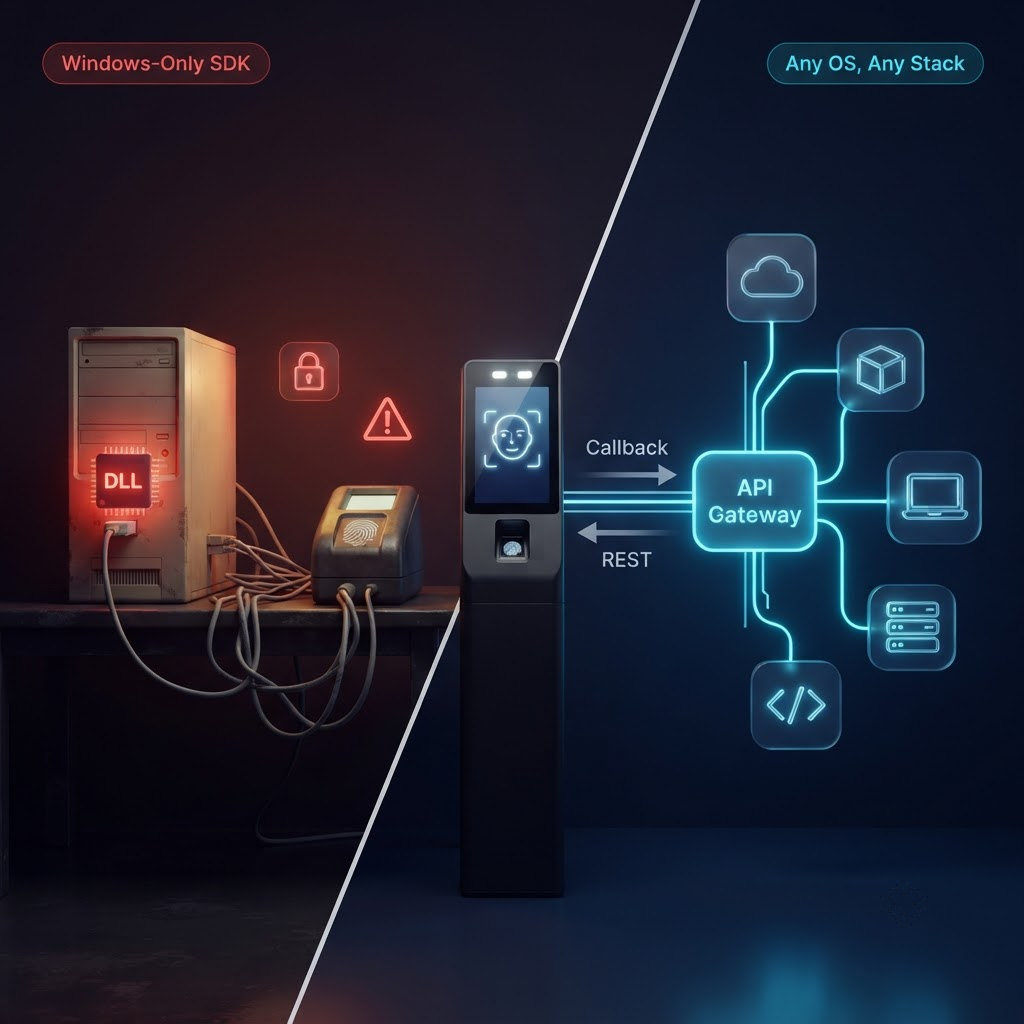
A proprietary protocol is a communication format designed and owned by a specific manufacturer, not openly documented and not usable by anything outside their own software. Most biometric manufacturers built these protocols in the early 2000s, long before AI agents existed. Devices were designed to talk exclusively to the vendor’s desktop attendance software via binary data packets, static IP addresses, and proprietary SDKs.
That architecture worked in 2005. In 2026, it makes your biometric system completely opaque to AI.
An AI agent operates as a stateless process. It cannot install software, maintain persistent connections, decode binary formats, or navigate private networks behind a static IP. If your biometric system requires any of these to be accessed, the AI agent cannot reach it. There is no workaround. The architecture is fundamentally incompatible.
The Three Barriers That Make Biometric APIs AI-Incompatible
When an AI agent encounters a biometric system it cannot use, the failure usually comes from one or more of three specific technical barriers. Understanding each one helps clarify exactly what needs to change.
“AI agents do not negotiate with systems they cannot read. They do not attempt workarounds. They simply route around the obstacle and use something that speaks their language. If your biometric system is not that something, it does not exist in your AI workflow.”
What AI Agents Actually Require: A Plain-Language Explanation
For any external system to be usable by an AI agent, it needs to meet a small but non-negotiable set of technical requirements. These are not arbitrary standards. They are the fundamental building blocks of how modern AI tools interact with the world.
Requirement 1: A REST API with HTTPS
REST (Representational State Transfer) is a design pattern for building APIs over standard web protocols. A REST API is a set of web endpoints that accept requests and return responses. Any system with a REST API can be called by an AI agent without installing anything.
Requirement 2: JSON Request and Response Format
Every request the AI agent sends and every response it receives must be in JSON format. It is the only format AI language models can reliably read and generate. When an AI agent enrols an employee, it sends a JSON object. When it queries attendance, it expects a JSON response it can interpret and act on.
// AI agent sends this to enrol a new employee
{
  "operation": "enrol_user",
  "device_id": "FACTORY_GATE_01",
  "employee_id": "EMP-4821",
  "name": "Rajan Sharma",
  "access_level": "production_floor",
  "shift": "morning"
}

// Cams Gateway responds with
{
  "status": "success",
  "employee_id": "EMP-4821",
  "enrolled_at": "2026-06-12T05:34:22Z",
  "device": "FACTORY_GATE_01",
  "audit_id": "AUD-98231"
}
Requirement 3: Stateless Operation
AI agents do not maintain persistent connections to external systems between tasks. Each interaction is a fresh, self-contained request. This means the biometric API must be stateless, meaning every request must carry all the information needed to process it, and every response must be complete on its own. Biometric systems that require an active session, a login state, or a persistent socket connection cannot meet this requirement.
Requirement 4: MCP Compatibility (for Advanced AI Integration)
The Model Context Protocol (MCP) is an emerging standard that allows AI agents to discover and interact with external tools in a structured, consistent way. An MCP-compatible server exposes a set of named operations (called tools) that an AI agent can call directly. Cams Biometrics Gateway is MCP-compatible, which means Claude AI and other MCP-supporting agents can call biometric operations as naturally as any other tool in their workflow.
Imagine giving an AI agent a toolbox. Each tool in the box is a specific action it can perform, such as sending an email, updating a calendar, or querying a database. MCP is the standard for how those tools are described, discovered, and used. Cams Biometrics Gateway adds a full set of biometric tools to that toolbox, making biometric operations as accessible to Claude AI as any other connected service.
Comparing Legacy Biometric APIs with AI-Ready APIs
Here is a direct comparison between how traditional biometric systems communicate and what Cams Biometrics Gateway provides instead:
What Cams Biometrics Gateway Is and How It Solves This Problem
Cams Biometrics Gateway is a universal API bridge that sits between your physical biometric devices and any AI agent, application, or workflow that needs to interact with them. It does not replace your existing hardware. It translates between the proprietary world your devices live in and the JSON world that AI agents operate in.
Here is how that translation works in practice:
The 38 Operations Cams Gateway Makes Available to AI
One of the most significant capabilities of Cams Biometrics Gateway is the breadth of operations it exposes through a single, unified API. These 38 operations cover the full lifecycle of biometric device management:
All 38 operations work identically regardless of the underlying device brand. Whether the physical terminal is a ZKTeco, Suprema, Hikvision, or Anviz device, the API call is the same. Cams Gateway handles the translation invisibly, meaning your AI agent never needs to know or care which hardware it is talking to.
Introducing Business-to-AI: Why This Is a New Category Entirely
B2A, Business to AI, Is the Third Model of Digital Commerce
For the past 30 years, digital business operated in two primary models. Business-to-Business (B2B) described systems where one company’s software communicates with another company’s software. Business-to-Consumer (B2C) described systems where a company’s software is used directly by end customers.
Cams Biometrics is defining a third model: Business-to-AI (B2A). In a B2A model, the primary consumer of your system is not a human user and not another business’s software. It is an AI agent. The API is not designed for a developer to integrate into an application. It is designed for an AI agent to call directly, autonomously, and continuously as part of its own decision-making and task execution workflow.
This distinction matters because it changes what the API must be. A B2B API can afford to have complex authentication flows, because a developer can figure them out. A B2A API must be discoverable, self-describing, and stateless, because an AI agent will not read documentation or troubleshoot a failing handshake.
Is Your Biometric Infrastructure AI-Ready? A Self-Assessment
Use this checklist to evaluate whether your current biometric system can be consumed by an AI agent today:
Your biometric system is currently invisible to AI agents. That does not mean replacing your hardware. Cams Biometrics Gateway connects to your existing devices and provides a fully AI-compatible JSON API layer on top of them, without changing your physical infrastructure.
The Universal Bridge Between AI Agents and Physical Biometric Devices
Cams Biometrics Gateway is the world’s first B2A biometric platform, purpose-built for AI agent consumption. One API. 15 plus device brands. 38 operations. Zero SDK. Fully compliant with global data protection standards.
Frequently Asked Questions
Conclusion: The Requirement Is Non-Negotiable, but the Solution Is Straightforward
AI agents are not difficult to integrate with. They are, in fact, remarkably straightforward to build workflows around, provided that every external system they need to access meets a simple, well-defined technical standard: clean JSON over HTTPS, stateless operation, and no SDK dependency.
Most biometric infrastructure was designed before these requirements existed, built for desktop software and local networks, not cloud-native AI agents. Cams Biometrics Gateway closes that gap, making 15 plus device brands and 38 biometric operations accessible to AI through a single standards-compliant API.