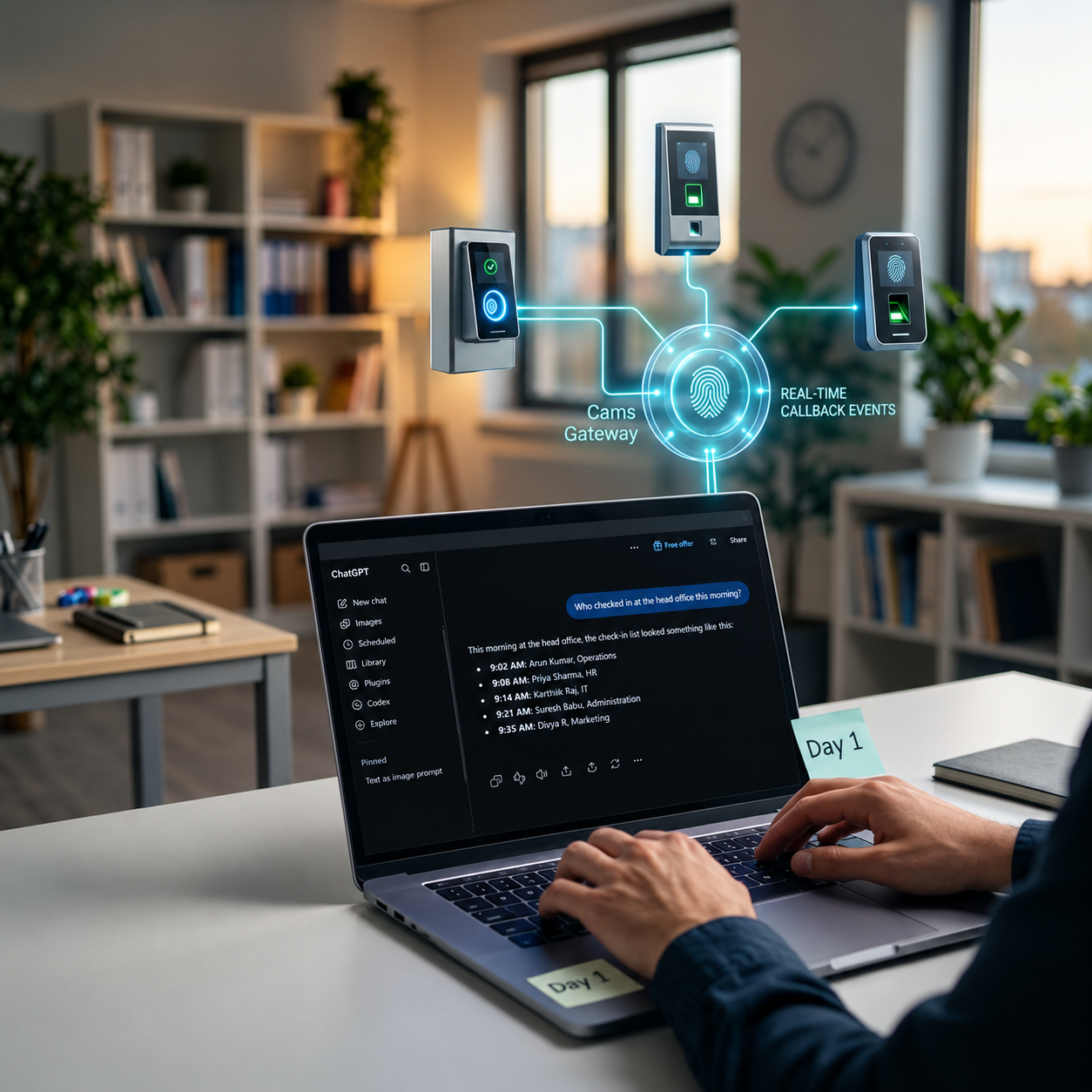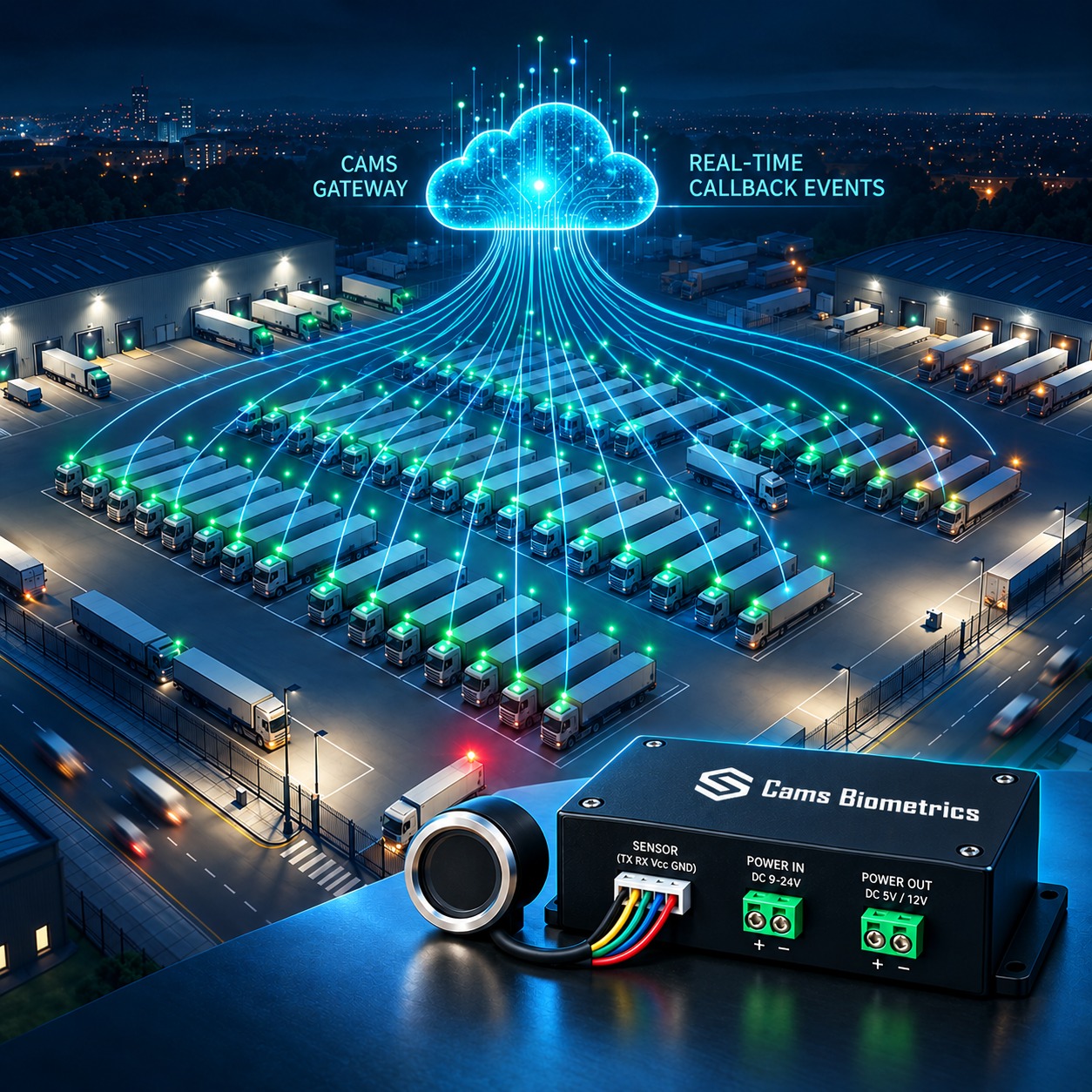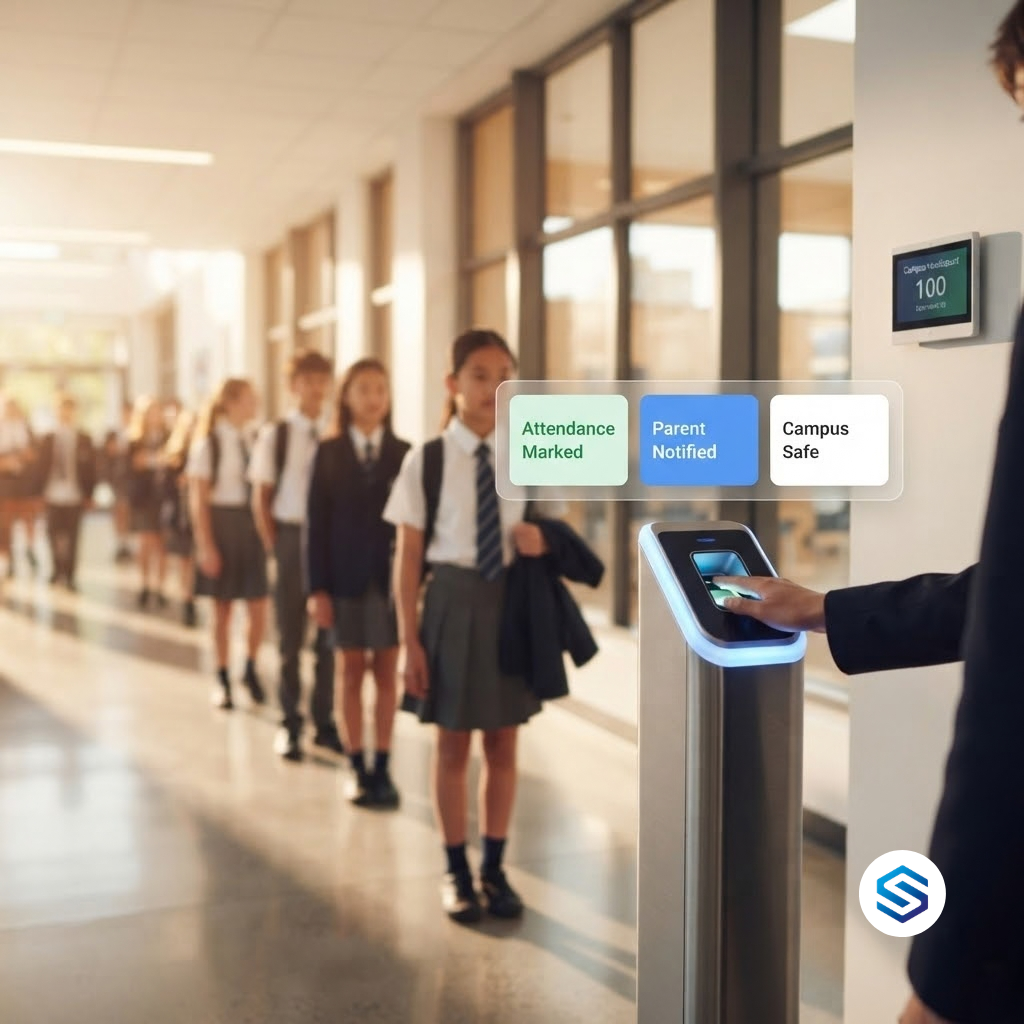





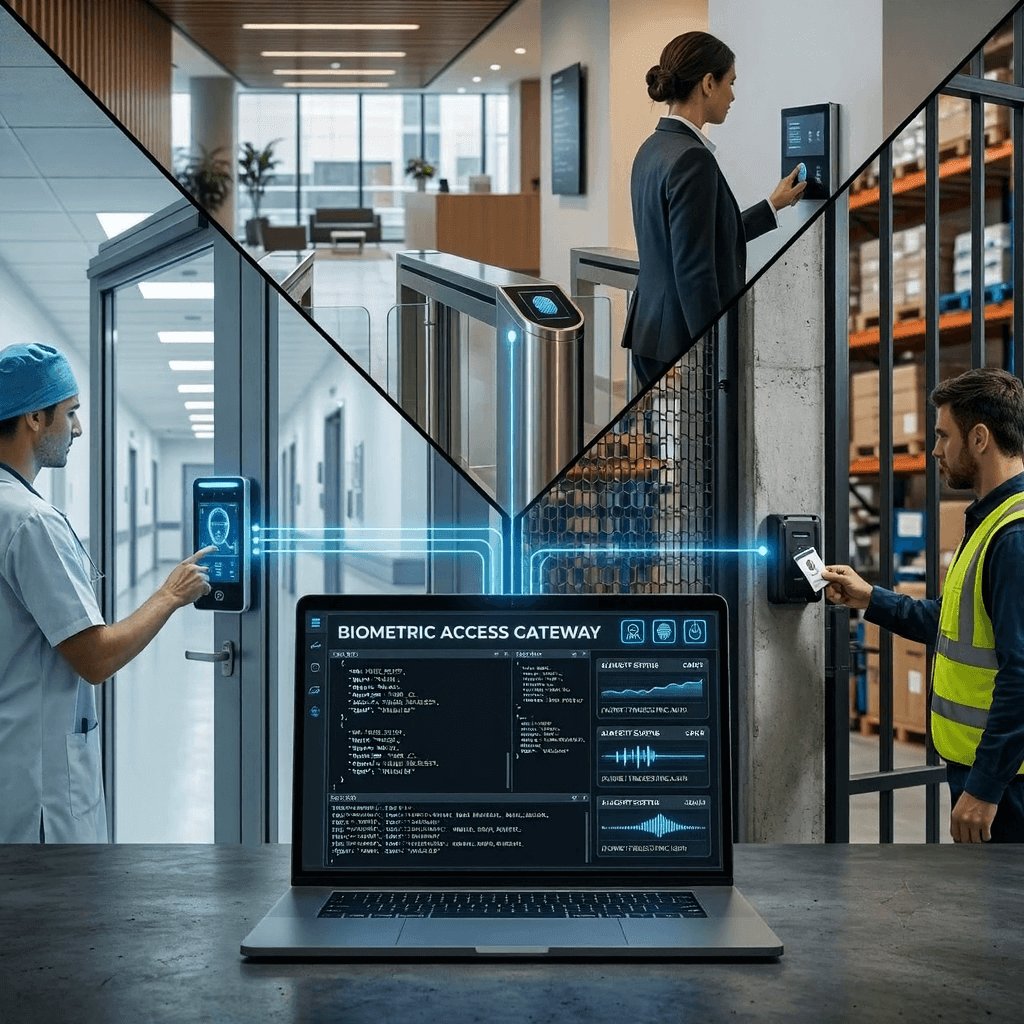
One JSON call. Fifteen or more device brands. Zero SDK. That is what is happening today across offices, hospitals, warehouses, schools, offices, and facilities worldwide. This article explains how any AI agent, whether ChatGPT, Gemini, Claude, or any other MCP-compatible model, connects directly to fingerprint readers, face recognition cameras, and RFID terminals through Cams Biometrics Gateway, and what that means for the future of physical security and workforce management.
What It Means for an AI Agent to Run Biometric Access Control
Access control has traditionally been a human-administered function. A security manager grants permissions. An HR administrator revokes them when someone leaves. An IT team pulls access logs for compliance audits. Each of these tasks requires a person to log into a system, navigate an interface, and take a deliberate action.
When we say an AI agent now runs biometric access control, we mean something specific and technically precise: any AI agent, whether ChatGPT, Gemini, Claude, or any other MCP-compatible model, can perform every one of those tasks autonomously, through a single API, without a human initiating or completing the action. It enrolls new staff. It revokes access for departed employees. It pulls 30 days of access logs. It detects anomalies. All of this happens through a structured conversation between the AI agent and Cams Biometrics Gateway, using nothing but JSON over HTTPS.
Access control refers to the systems and processes that determine who is allowed to enter specific areas of a facility, when they are allowed to enter, and what happens when access is attempted by someone without permission. In any workplace setting, this typically involves biometric devices at entry points that verify identity before unlocking doors or gates.
Understanding the Technology Stack Behind This
To understand how Claude AI manages physical biometric devices, it helps to understand the three layers of technology that make it possible. Each layer has a specific job, and together they create a complete, autonomous access control system.
The Model Context Protocol (MCP) is a standard that allows AI agents to discover and use external tools in a consistent, structured way. Think of it as a universal plug socket for AI capabilities. Cams Biometrics Gateway registers itself as an MCP server, which means any MCP-compatible AI agent, including ChatGPT, Gemini, Claude, and others, can find it, understand what it can do, and call its operations exactly as it would call any other connected tool, without any custom integration code.
A Real-World Scenario: What This Looks Like in Practice
Abstract explanations only go so far. Here is a concrete example of how the enrolment process actually works, from the moment a new employee speaks to HR, to the moment the audit log is written automatically.
A new employee arrives at the workplace for their first day. They walk up to the HR manager and introduce themselves, explaining they need to be enrolled into the access control system. The HR manager opens a conversation with the AI agent and simply says: “Please enrol this new employee and assign them the appropriate access level.” The AI agent, connected via MCP to Cams Biometrics Gateway, takes it from there. It creates the user record, sends the enrolment request to the correct biometric terminal, assigns the access level, and writes a timestamped audit log entry confirming the action. The HR manager does not touch the device, log into any software, or manually configure a single setting. One instruction. Everything else is handled.
This is the key distinction of a B2A workflow. The human, in this case the HR manager, remains in control by giving the instruction. The AI agent handles all of the technical execution. No one needs to know which device brand is installed, which protocol it uses, or how to navigate a device management interface. The AI agent knows, and the Cams Biometrics Gateway handles the rest.
What Any AI Agent Can Do with Your Biometric Devices
Through Cams Biometrics Gateway, any AI agent gains the ability to perform the full range of access control and attendance management tasks that would otherwise require human administration. Here is what each capability means in practice:
Enrolling New Workers
When a new employee or contractor joins, your AI agent can initiate and complete the biometric enrolment process automatically, triggered by an HR system event, a scheduled onboarding workflow, or a direct instruction from a manager. The worker’s fingerprint or facial data is captured and associated with their employee record, access level, and shift schedule without anyone manually operating the device.
Pulling Access Logs
Compliance audits, incident investigations, and attendance reports all require access to historical entry and exit records. Your AI agent can retrieve 30 days of access logs, or any defined period, from any device or combination of devices across all sites, and return them as structured, analysis-ready data. A task that might take an administrator hours to compile manually takes Claude seconds.
Revoking Access Instantly
When an employee is terminated, their access should be revoked immediately. In traditional systems, this requires someone to remember to update every device the employee was registered on, often across multiple sites. Your AI agent can revoke access across all connected devices simultaneously, the moment it receives the instruction, with a full audit trail of when the revocation occurred and which devices were updated.
Detecting and Responding to Anomalies
Claude monitors access patterns continuously. Repeated failed attempts, access at unusual hours, the same credential used at two distant locations within an impossible timeframe, all of these are anomalies that your AI agent can detect, flag, and act on automatically, without waiting for a human to notice a pattern in a report.
“The future of physical security is not more administrators. It is a smarter AI agent that never clocks out, never misses an anomaly, and never forgets to revoke a terminated employee’s access, whether you run a hospital, a warehouse, a school, or a corporate office.”
The Role of JSON in Making This Possible
Every interaction between your AI agent and Cams Biometrics Gateway happens through JSON over HTTPS. Understanding why this matters requires understanding what JSON is and why AI agents depend on it.
JSON stands for JavaScript Object Notation. It is a lightweight, human-readable data format that uses key-value pairs to structure information. It is the universal language of modern web APIs, and it is the only format that AI language models can reliably read, generate, and reason about.
When an AI agent needs to enroll a new employee, it does not open a software interface or click through menus. It constructs a JSON object describing the action and sends it to the Gateway. The Gateway executes the action on the physical device and returns a JSON response confirming the outcome.
{
  "Add": {
    "User": {
      "UserID": "1",
      "FirstName": "Manu",
      "LastName": "Mona",
      "UserType": "User"
    }
  },
  "OperationID": "1jxpjeoasu8wl",
  "AuthToken": "COJ J7eiPBGUfmIQPvh2PJWWDLX7OuKs",
  "Time": "2020-09-17 11:09:09 GMT +0530"
}
{
  "Status": "done",
  "OperationID": "1jxpjeoasu8wl",
  "StatusCode": 0
}
This exchange is the entirety of the enrolment process from Claude’s perspective. No SDK. No custom integration script. No vendor software. Just a structured request and a structured response over a secure HTTPS connection.
How the Gateway Connects to Physical Devices
The challenge that Cams Biometrics Gateway solves is a fundamental one: physical biometric devices from different manufacturers speak completely different technical languages. A ZKTeco terminal uses one proprietary protocol. A Hikvision device uses another. A Suprema reader uses a third. None of these were designed to be consumed by AI agents.
Gateway acts as a universal translator. It connects to each device using its native protocol, ICLOCK, TCP/IP push, binary SDK protocol, or any other format, and then exposes every device operation through a single, standardised JSON API. From the AI agent’s perspective, all devices are identical. The same JSON call works identically across every supported brand, so your AI agent, whether ChatGPT, Gemini, or Claude, never needs to know or care which hardware it is talking to.
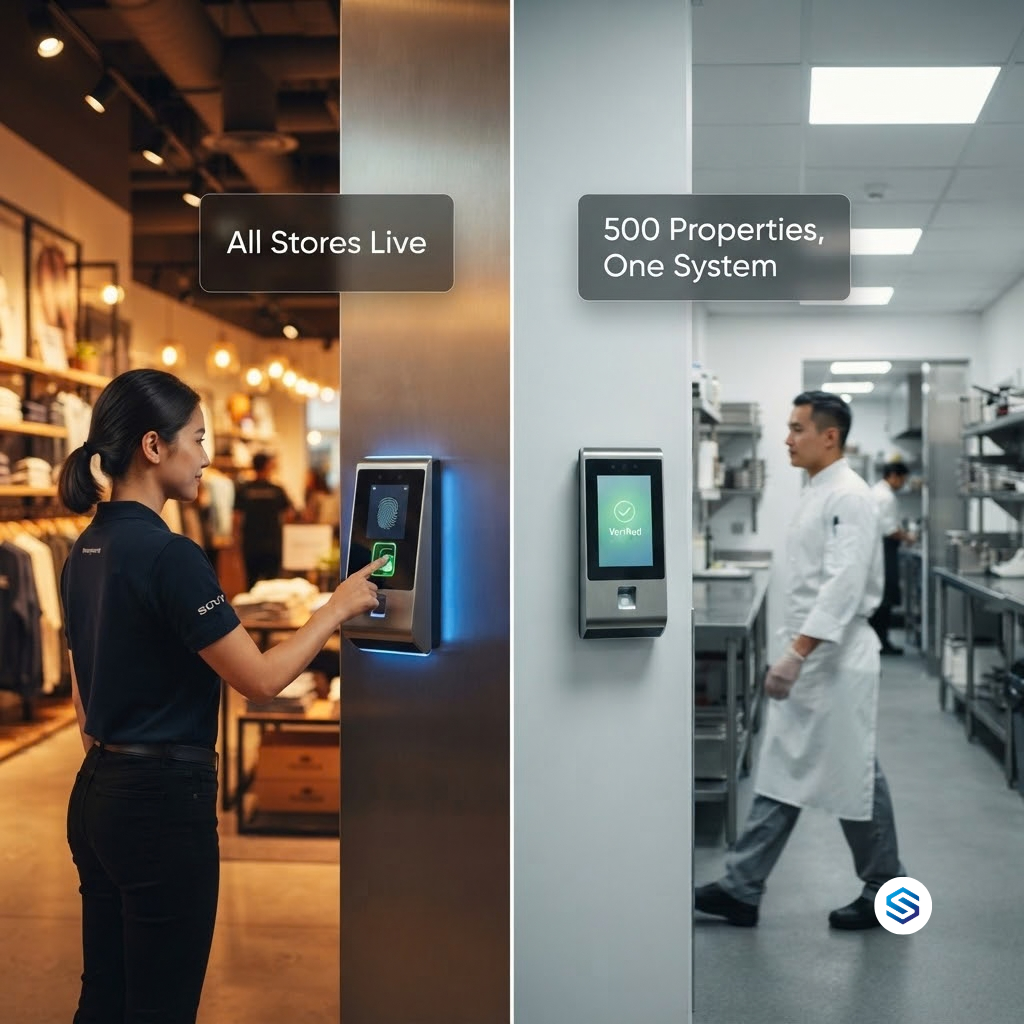
Most organisations, whether hospitals, hotels, corporate offices, schools, or manufacturing facilities, do not have a single uniform device brand across all locations. Different sites, different entry points, and different legacy installations mean mixed hardware is the norm rather than the exception. Cams Gateway handles this mixed environment as a single unified API surface, meaning any AI agent manages every device through the same interface regardless of what hardware is physically installed.
The Complete Set of Operations Available to Claude AI
Cams Biometrics Gateway exposes operations covering the full lifecycle of biometric access control management. Every one of these can be called by any AI agent through a single JSON request:
All operations work identically regardless of the underlying device brand. Whether the terminal is a ZKTeco, Suprema, Hikvision, or Anviz device, the JSON call is the same. Cams Gateway handles the device-specific translation invisibly, so your AI agent never needs to know or care which hardware it is talking to.
How Claude AI Connects to Gateway: The MCP Flow Explained
The Model Context Protocol is what makes the connection between any AI agent and Cams Biometrics Gateway seamless and standardised. Here is how that connection is established and how it works in practice:
Comparing Traditional Access Control with AI-Managed Access Control
Introducing B2A: Business to AI, the New Operating Model
B2A, Business to AI, Is the Model Where AI Agents Become the Operators
For decades, physical security infrastructure was managed by people using software. The software was a tool that humans operated. In that model, the human is always the primary actor and the software is always the instrument.
Cams Biometrics is defining a different model called Business-to-AI (B2A). In B2A, the AI agent is not a tool that humans use to manage devices. The AI agent IS the operator. It receives context, makes decisions, calls device operations, interprets responses, and logs outcomes, all autonomously. The human role shifts from administration to oversight.
This shift has profound practical implications. A B2A biometric system does not have business hours. It does not forget to revoke access. It does not need to be reminded to run a compliance audit. It does not require a dedicated administrator to monitor for anomalies. These functions happen continuously as a natural function of the AI agent’s operation.
Data Security and Compliance in an AI-Managed System
When an AI agent manages biometric data autonomously, data protection becomes a central concern. Every operation any AI agent performs through Cams Biometrics Gateway is governed by the same rigorous data protection principles that underpin the entire platform.
- GDPR (EU): All biometric data is handled with data minimisation principles. No AI agent connected via Gateway stores or transfers data beyond what is required for each specific operation.
- CCPA and CPRA (California): No personal data is collected, sold, or used for profiling by Cams Biometrics or any connected AI agent operating through Gateway.
- LGPD (Brazil): All processing aligns with lawful processing grounds and transparency requirements under Brazilian data protection law.
- PDPA (Singapore, Malaysia, Thailand): Consent-based processing principles are maintained. Every AI-initiated action is logged with full justification records.
- ISO 27001-aligned controls: Encryption in transit, access control, and security readiness practices reflect ISO 27001 guidelines throughout the Gateway platform.
Every action Claude AI performs through Cams Gateway is logged with a full record of what was done, what triggered it, and what data was accessed. There are no unexplained automated actions. Every autonomous biometric event has a complete, reviewable audit trail that satisfies compliance requirements without any manual compilation.
The Universal Bridge Between Any AI Agent and Physical Biometric Devices
Cams Biometrics Gateway is the world’s first B2A biometric platform, purpose-built for AI agent consumption, whether you use ChatGPT, Gemini, Claude, or any other MCP-compatible model. One API. Fifteen plus device brands. 38 operations. Zero SDK. Fully compliant with global data protection standards.
Frequently Asked Questions
Conclusion: Your AI Agent, Whichever One You Choose, IS the Operator
For most of the history of physical access control, the security system was only as responsive as the person managing it. An employee could remain enrolled on a device for days after termination simply because no one had gotten around to removing them. A compliance audit could take a week to prepare because access logs had to be manually compiled from multiple systems.
That is the world Cams Biometrics Gateway and AI agents are replacing. Not with more administrators. Not with more dashboards. With an AI agent that is always present, always attentive, and always capable of acting the moment action is needed.
One JSON call. Fifteen or more device brands. Thirty-eight operations. Zero SDK. This is what B2A looks like in practice, and it is running across offices, hospitals, warehouses, schools, and facilities worldwide today, with whichever AI agent your organisation already uses.