




Labour is the largest controllable cost in retail and hospitality, typically between 25 and 35 percent of revenue. When attendance is managed manually, a percentage of that cost leaks through time theft, buddy punching, unrecorded early departures, and payroll errors that no one audits until the end of the month. For a chain with 80 stores or 500 hotel properties, these leaks are not rounding errors. This article puts numbers on the problem, explains why standard biometric solutions fall short in high-turnover, multi-location environments, and shows what the Cams Biometric Gateway delivers that changes the commercial equation.
Multi-Location Retail: Centralised Control, Local Execution
The labour cost problem in multi-location retail is not primarily a technology problem. It is a visibility problem. Every store manager knows what is happening in their own store. The regional manager knows what is happening in their region only after making a round of phone calls. The operations director at head office knows what happened last month, because that is when the consolidated payroll data arrives. By the time a labour cost anomaly is visible at head office, it has been running for 30 days.
Time theft in retail takes three forms. The first is buddy punching: a colleague clocks in for a staff member who has not yet arrived. The second is early clock-out: a staff member leaves before the end of their shift but records a full shift. The third is rounding abuse: manual time records are rounded to the nearest 15-minute increment, and in stores where managers are under pressure, rounding consistently favours the staff member. In a chain with 80 stores and a payroll of 1,200 staff, even modest leakage across all three forms adds up to a material payroll overpayment every month.
15 staff
1,200 staff
4.5 hours per staff per month
$12 per hour
$64,800
$777,600
Biometric attendance eliminates all three forms of time theft simultaneously. A fingerprint or face recognition terminal cannot be delegated. The person scanning is the person being recorded, at the exact time they scan, with a timestamp that your payroll system receives directly through the Cams Gateway Callback API. Rounding becomes irrelevant because the system records to the second, and your payroll software applies its own rounding rules to verified data rather than to self-reported times.
What centralised control with local execution looks like in practice
The architecture is straightforward. Each store’s biometric terminal connects to Cams Gateway under the retail chain’s account, organised into store-level device groups. Every scan at every store sends a real-time Callback event to the central HR or payroll system, with the store identified by the LabelName in the payload. Head office sees live data from all stores. The store manager retains full operational authority. Nothing changes about how they manage their team day to day except that the attendance record feeding payroll is verified, timestamped, and delivered automatically rather than compiled manually at the end of the month.
When a new staff member joins the chain, the central HR system triggers a RESTful API call to Cams Gateway. The staff member is provisioned to the relevant store devices automatically. When they are terminated, the same call removes their access across all devices immediately. No local IT involvement. No physical device visit. No window during which a terminated staff member’s credentials remain active at a store they no longer work in.
Staff Attendance and Shift Management for Restaurant Chains
Running attendance for a restaurant is harder than running it for a retail store for four specific reasons that compound each other. Staff turnover in quick service restaurants can exceed 150 percent annually, meaning the roster changes faster than most systems can track. Split shifts mean a single staff member might touch four separate time entries in one day. Zero-hours and variable-contract workers need precise minute-level records for legal compliance. And the shift pattern in a restaurant does not respect the boundaries of a standard working day.
A kitchen porter working a split shift scans in at 09:45 for brunch prep, scans out at 14:30, scans back in at 17:00 for evening service, and scans out at 23:15. That is four separate attendance events in one day. A paper register or a basic time clock handles this poorly, because the system must match the out-scan to the correct in-scan without human interpretation. Biometric terminals connected to Cams Gateway produce four separate Callback events, each with a precise timestamp and the staff member’s ID. Your payroll software receives the events and applies its own shift grouping logic to verified data, not to manually entered records.
Why buddy punching is a bigger commercial problem in restaurants than retail
In a retail store, buddy punching typically involves one staff member clocking in for a colleague who is running 10 to 20 minutes late. In a restaurant, the dynamic is different. On a busy Friday evening service, a senior kitchen member may clock in for a junior who has not arrived yet specifically to avoid a service gap being recorded. The motivation is operational cover rather than personal favour, but the commercial consequence is the same: wages are paid for hours not worked, and the attendance record misrepresents actual staffing.
Every scan generates a Callback event with an exact timestamp delivered to your payroll system. Your payroll system groups events into shifts using its own configured rules. Buddy punching is impossible because the biometric cannot be transferred. New staff are enrolled through the RESTful API the day they join without any physical device visit, which matters when a new casual worker starts with 48 hours notice. Staff on zero-hours contracts have precise minute-level records for the compliance evidence their contracts require.
Face Recognition: Why Hospitality Stopped Using Fingerprint Readers
The adoption of face recognition terminals in global hospitality is not a technology preference. It is a response to a specific operational failure that fingerprint readers produce consistently in back-of-house environments, and that fingerprint reader manufacturers have not solved in fifteen years of trying.
Kitchen staff, housekeeping teams, spa therapists, and maintenance crews all work with their hands in conditions that degrade fingerprint sensor accuracy. Gloves block the sensor entirely. Cleaning chemicals dry and damage the epidermal layer that fingerprint readers rely on. Heat and moisture from kitchen environments affect fingertip surface texture. These are not edge cases. They are the standard working conditions for the majority of staff in any hotel or restaurant. When a fingerprint reader fails to scan, the staff member signs a paper backup register. The biometric system that was supposed to eliminate paper attendance has created a paper shadow system running alongside it.
The Callback payload from a face recognition terminal is structurally identical to that from a fingerprint terminal. The InputType field reads FaceRecognition instead of Fingerprint. Every other field is the same. Your payroll system receives and processes face recognition attendance events exactly the same way it processes fingerprint events, with no separate integration required for different input types.
{
  "RealTime": {
    "OperationID": "9nu1wak5616p",
    "LabelName": "Kitchen Staff Entrance, Level 2",
    "SerialNumber": "ZHM11xxxxxxxx",
    "PunchLog": {
      "Type": "CheckIn",
      "InputType": "FaceRecognition",
      "UserId": "3847",
      "LogTime": "2026-08-01 14:55:02 GMT +0530"
    },
    "AuthToken": "COJJ7eiIPBGUfmIQPvh2PJWWDLX7OuKs",
    "Time": "2026-08-01 09:25:02 GMT +0000"
  }
}
A hospitality group that deploys fingerprint readers at office and management entrances and face recognition terminals at all back-of-house locations manages both through the same Cams Gateway account. One Callback endpoint receives events from both input types. One RESTful API provisions staff across all terminals regardless of the device brand or input method at each location.
Real-Time Attendance for Store Managers: No More Manual Reports
The store manager’s attendance problem is not a data problem. The data exists. It is a timeliness problem. The data that would allow a manager to act on a staffing gap arrives too late to act on. A staff member who was supposed to open the store at 7am but has not arrived by 7:15am is a problem that needs a decision in the next five minutes. A paper register cannot surface that problem. A daily attendance report emailed at 6pm cannot surface it either. Neither can a weekly report that lands on a regional manager’s desk on Friday.
“The store manager does not need a report. They need to know right now whether the store is staffed correctly. Those are completely different requirements.”
What real-time means for a store manager specifically
When Cams Gateway delivers a Callback event to your store management system or ERP the moment a staff member scans, your software has current data to work with. If your software is configured to monitor scheduled arrivals and actual arrivals, it can detect a gap and surface it to the manager the moment the scheduled start time passes without a Callback event for that staff member. The manager receives a notification from their own system, not from Cams Gateway. Cams Gateway is the data source. Your store system is the notification engine.
Cams Gateway pushes verified attendance event data to your store management system or ERP. Your software receives this data and applies its own business rules: shift schedules, contracted hours, absence thresholds, overtime limits. The alerts, notifications, and escalations that result from those rules are triggered by your software, not by Cams Gateway. This means your existing alerting logic, configured in the system your managers already use, applies to verified biometric data rather than to manually entered records.
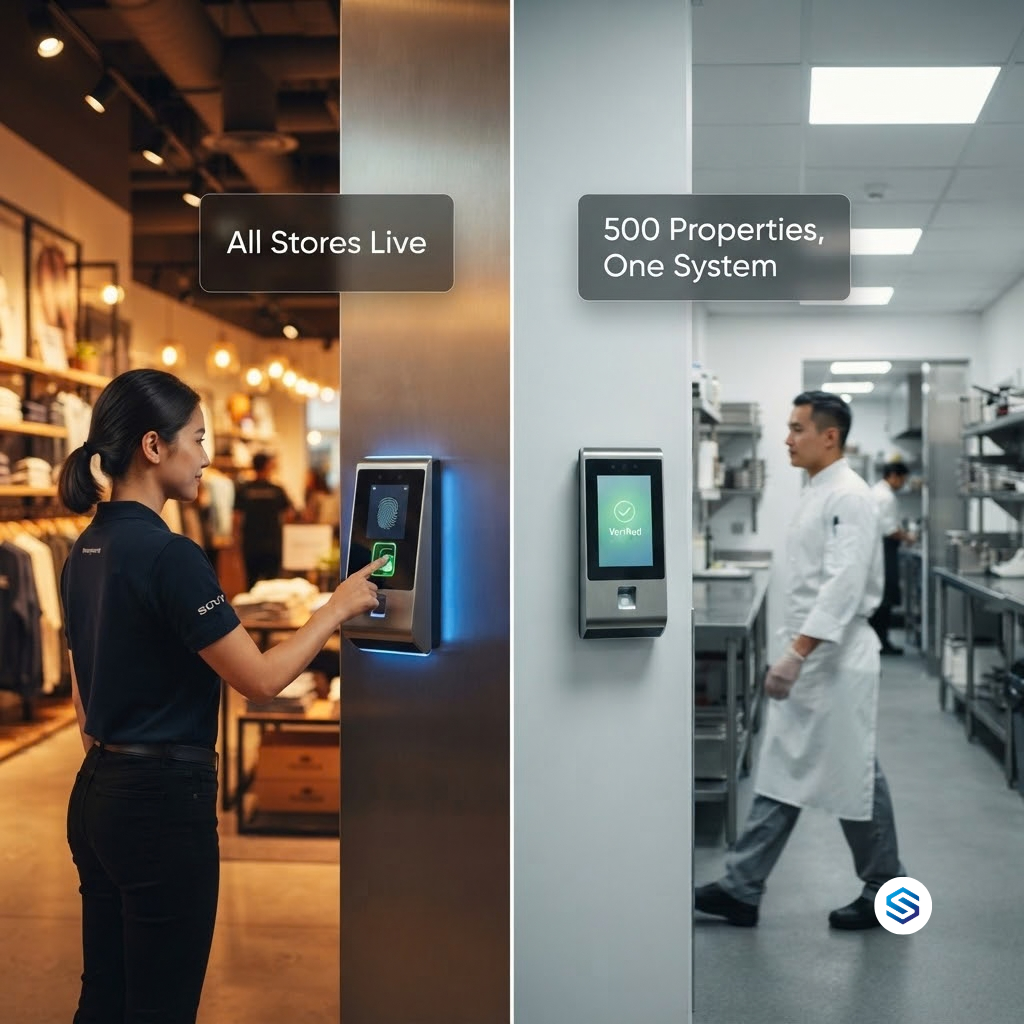
Case Study: Hotel Chain Unified 500 Plus Properties
What changed after unification through Cams Gateway
Conclusion: The Commercial Case for Biometric Attendance in Retail and Hospitality
Labour is the largest controllable cost in retail and hospitality. When attendance is managed manually, a fraction of that cost leaks every month through time theft, buddy punching, undetected early departures, and payroll consolidation errors. When attendance is managed through verified biometric data delivered in real time to the systems that calculate wages, that leakage stops. The payroll system receives exact timestamps for exact people. It applies its own rules. It produces a payroll that reflects what actually happened.
The secondary benefits are commercial too. A store manager who knows in real time whether their store is correctly staffed makes better decisions about cover, overtime, and service quality. A regional manager who sees live data across 80 stores without making 80 phone calls spends that time on higher-value work. A hotel group that eliminates eight days of monthly payroll consolidation work recovers the equivalent of a full-time role per year.
Cams Biometrics Gateway is the infrastructure that makes this possible across retail and hospitality at any scale. It supports ZKTeco, Hikvision, Suprema, Anviz, and 11 more device brands through one unified API. The Callback API delivers real-time, verified attendance events to your HR, payroll, or store management system. The RESTful API handles staff provisioning, transfers, and terminations across any number of locations. Face recognition and fingerprint events arrive in the same JSON structure. AES-256 encryption is available on all communication. And one Gateway account spans 500 plus properties across 22 countries. Explore the full API at CamsBiometrics.com about your chain’s specific requirements.